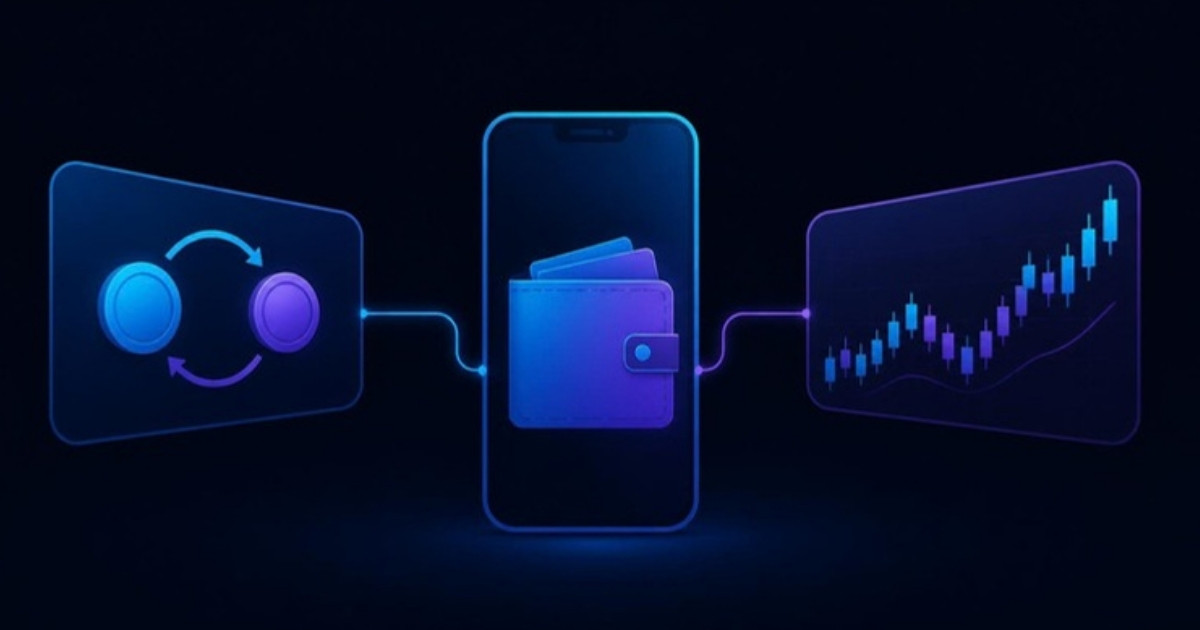
Opening an exchange account is not the only way to invest in crypto assets. You can also invest while the assets stay in a wallet you control.
This describes two tools – Uniswap Wallet and Hyperliquid – the different job each does, and the common pitfalls, based on information and service specifications as of September 2026.
It is not for anyone who cannot accept losing money. Both can lose it, and unlike an exchange, nobody is there to help when you get it wrong.
Three kinds of investing from a wallet
- 1. Holding. Keep Bitcoin or Ethereum in the wallet. The valuation moves, but nothing is realised until you sell. It requires the fewest decisions of the three.
- 2. Swapping. Exchanging ETH for USDC inside the wallet. The important part is that a swap settles a gain or a loss at that moment, whether or not you convert back to yen.
- 3. Taking a position. Perpetual futures, betting on a price rising or falling. A small sum controls a large one, and if the read is wrong the deposit can be gone in moments.
The three differ in risk by orders of magnitude. The one word, investing, covers three different things.
Uniswap Wallet – a wallet for holding and swapping
Uniswap Wallet is a self-custody wallet from Uniswap Labs, who build the decentralised exchange. There is a phone app and a browser extension, and both act as the same wallet.
You hold ETH and USDC at your own address, swap inside the app, and pay people with it.
One feature is that the wallet and the place you swap are one thing. The sequence – open a swap site, connect the wallet, approve, trade – happens inside the app.
- Fees. Fees differ from network to network. Ethereum itself gets more expensive when it is busy.
- Fake tokens with real names. Anyone can create a token, so well-known names appear more than once. Verify by contract address, not by search order.
- “Approve” hands over permission. Refuse connection requests from sites you did not go looking for.
- Keep records. Date, quantity and yen value at the time of each swap.
Two checks in any swap or transfer
Two checks apply to a swap or a transfer, whichever wallet is used.
- Check the network on both sides. The same coin exists on several chains. Sending on one the receiver does not use is the classic way funds go missing.
- Read the confirmation screen. Look at the amount you will receive and the fee before you sign, not after. If either looks odd, cancel and start again.
Hyperliquid – how perpetual futures work, and what can happen
Hyperliquid is an on-chain exchange you use by connecting a wallet. There is no account opening. You connect, sign, and deposit USDC as margin. No email address and no password are created.
- Liquidation is real. With leverage, a small adverse move takes the whole margin. That is the design, not a malfunction.
- There is no yen on-ramp. Margin is USDC. Yen cannot be deposited as it is.
- There is effectively no support desk. Send to the wrong place and it is gone.
- A cost you do not see. Holding a position exchanges funding payments periodically.
Uniswap Wallet and Hyperliquid do different jobs
They are not competitors; they do different jobs. Uniswap Wallet is a wallet for keeping crypto assets in your own custody and swapping them.
In this article, Hyperliquid is treated as a venue for trading perpetual futures.
Perpetual futures can take the entire margin you deposit. We do not recommend using them.
Margin that is added can also be lost in full.
✅ What tends to work
Writing down the date, the quantity and the yen value on the day of each swap or transfer. It makes it easier to check later how much is held.
⚠️ Common pitfalls
Early on, small positions do not move enough to feel like anything, so the leverage goes up. A small move in the wrong direction can then take the margin in minutes.
- Leverage is not a multiplier on gains; it shortens the distance to the end.
- Feeling that it is not moving enough is not a signal to increase the size. It may be a signal that this is not for you.
This section describes the different jobs the two do. Nothing in this article is a recommendation to trade crypto assets or to use any particular wallet or exchange.
The problem nobody warns you about: losing track
The part that catches people is often not the losses. It is not knowing how much they have. Balances are denominated in crypto rather than yen, and assets are spread across chains.
Margin deposited on Hyperliquid does not appear in the wallet balance at all. Transfers show a counterparty as a string of characters, so the purpose is unrecoverable later. Trying to review a year in that state is genuinely hard.
Three things cause the confusion, and each has a dull fix:
- Denomination. Write down the yen value on the day of anything that settles. The number in ETH tells you nothing six months later.
- Fragmentation. Keep a short list of the chains you actually use, and check them on the same schedule rather than whenever something reminds you.
- Counterparties. Label the addresses you send to and receive from more than once. The string itself will never mean anything to you again.
Even with those habits, reviewing by hand is slow. Once the number of transfers grows, a tool that shows everything in yen is one way to keep up.
💡 To see scattered holdings in one place, in yen
Crypto Wallet Viewer shows wallet balances and transfers (Ethereum and Solana) on a single page. Viewing needs only the address, never a private key. It needs an account and is a paid service. The site is in Japanese.
To set a limit on the funds you use before you start, the funding plan table in Hype Trade lists how the balance would look after a run of wins or a run of losses.
It is a guide for money management, not a trading recommendation. No login is needed.
→ Crypto Wallet Viewer (wallet balances and transfers)
→ Hype Trade: funding plan table (no login; page opens in Japanese)
(Published 4 August 2026, updated 15 September 2026. Based on information as of September 2026. Crypto assets are highly volatile, and with perpetual futures an adverse move can take the entire deposited margin. This describes tools; it does not recommend buying or trading)
On 9 October 2026, the guides on what share of assets to keep where, when to swap, which network to choose and how to start were removed, and the second figure was redrawn. The information was not retrieved again.
Categories