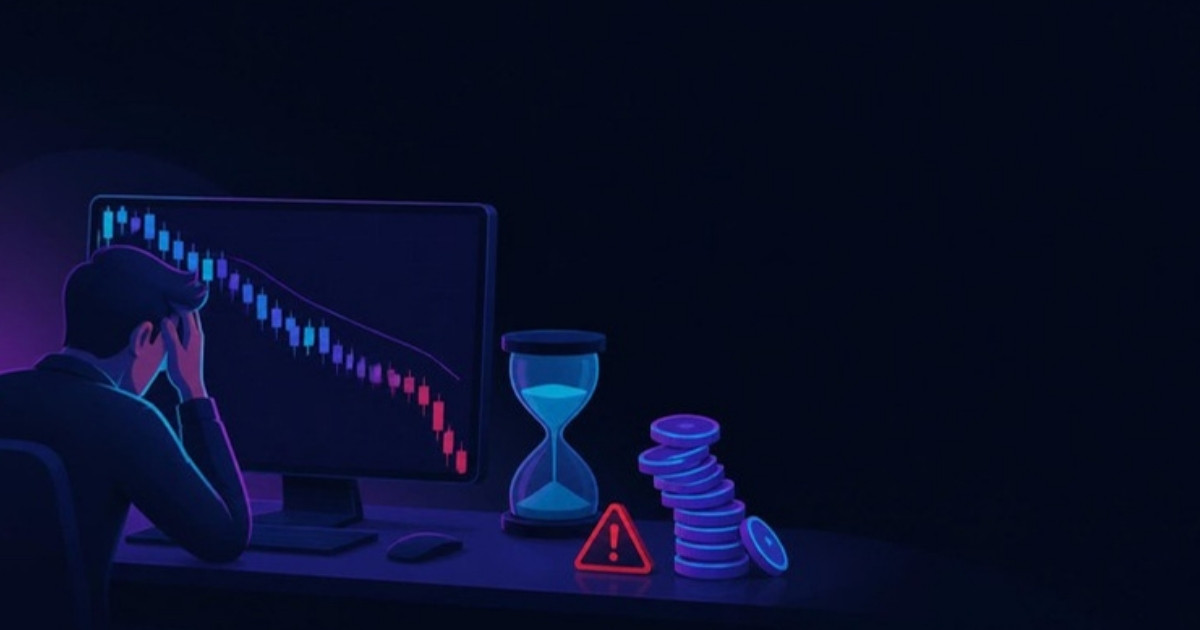
A losing position is not something to avoid. It is something to build on purpose. Before you enter, you decide how much you will lose if the trade goes wrong, and you arrange things so that is exactly what you lose.
There is one reason for doing this: so that your past losing positions can be the baseline for choosing your next lot size.
When your losses are all roughly the same size, your record becomes a yardstick you can size positions with.
It is written for people who trade crypto perpetual futures with margin, describes things as of 25 September 2026, and is not advice to buy or sell anything.
By the end you will know three things:
- why losing positions should be built on purpose
- how to calculate a lot size from your past losing positions
- what to decide before you enter, so that each loss is the one you planned
Every figure in the article is a worked example for illustration. None of them is anyone’s actual trading result.
Why build a losing position on purpose?
As long as you keep trading, losses will come. No method wins every time. Since losses cannot be removed, the one thing you can control is how big each loss is.
If every loss is a different size, your record cannot tell you how many units to trade next. An average of a -10 loss and a -300 loss is not a useful guide to anything.
Without a baseline, three things tend to happen:
- The lot creeps up too far: the urge to win losses back raises the number of units with nothing to justify it
- You drift to other coins: you leave the coin that lost you money, so no comparable record builds up
- You cannot tell what to fix: looking back through your history, you cannot tell which loss came from which mistake
All three come from having no baseline for how big a loss should be. With one, the lot size comes from a calculation, the record for one coin keeps growing, and a loss that broke the rule stands out at once.
A loss whose size you fixed before entering is different. If every loss is planned, the losses in your record come out at roughly the same size, and together they tell you how much you tend to lose per unit.
Once you know that, the next lot size follows from one line: the loss you accept on one trade divided by the loss per unit. There is no room left for sizing by gut feeling or mood.
This is also why a record full of unplanned losses is hard to learn from. The numbers are there, but they describe how a trade went wrong rather than how you intended to trade.
The key point: you build losing positions on purpose so that past losing positions can serve as the baseline for your lot size. Losses of random size cannot do that.
When a loss larger than the baseline appears in your record, that is the thing to fix. Checking which of the four steps below made it larger tells you what to change next.
Unplanned losses come from four steps
The losses that cannot serve as a baseline are the ones that grew without a plan. Most of them come from the same few steps taken after a wrong call.
Step 1 is opening a position without a stop-loss line. Step 2 is waiting for an unrealised loss to come back. Both remove any ceiling on how much a single trade can lose.
Step 3 is going bigger to win back earlier losses. Step 4 is adding to a losing position, often called averaging down. The margin stays the same while the lot grows, so the liquidation price moves towards your entry.
Each step changes the size of the loss from one trade to the next. Building a loss on purpose also means deciding, before you enter, that you will not take any of these four steps.
Sizing your lot from past losing positions
There are four steps. With a comparison that splits your closed positions into wins and losses, the calculation takes a few minutes.
- filter to one side (long or short) and one coin at a time
- read the average amount and average lot of the losing side (ten or more losses is better)
- loss per unit = average loss / average lot of the losses
- next lot size = the loss you accept on one trade / loss per unit
Here is the worked example. If your losing positions average -90 USDC on an average of 10 units, you lose about 9 USDC per unit.
With a balance of 3,000 USDC, deciding to accept 1% of the balance on a single trade gives 30 USDC. 30 / 9 is about 3.3 units, so you round down and enter with 3.
You filter by side and coin because a unit of one coin can cost very differently from a unit of another. An average that mixes them is not a yardstick for either.
To be more cautious, use your largest single loss instead of the average, converted to a per-unit figure. The lot size comes out smaller, but it leaves room for a loss larger than you expected.
The average amount here means realised profit or loss after fees, so fees are already part of the per-unit figure. Funding payments over a long hold are not, which is another reason to keep holding times short.
What to decide before you enter
To keep the losses in your record the same size, decide these three things before entering and do not change them once the trade is on.
- Stop-loss line: the price at which you close. Place the order when you enter
- Lot size: the number of units from the calculation above. Do not raise it after a loss
- Maximum holding time: past this point you review the trade, whether it is winning or losing
Do not average down unless scaling in was part of the plan from the first entry. Adding changes the loss you decided on, and the record stops lining up.
Check the liquidation price before entering as well. If it sits beyond your stop-loss line, the trade can lose the amount you decided, and no more, before the exchange steps in.
Check your record for losses of a consistent size
Whether your losses are really being built on purpose shows up in the same comparison after the next 20 or so closed positions.
- Is the average loss close to the loss you accepted per trade?
- Is the average holding time of losses not far longer than that of wins?
- Is the average lot of losses not larger than that of wins?
If all three hold, your losses are the size you intended. Use that record to recalculate the next lot size.
✅ What tends to work
Recalculate the loss you accept per trade whenever your balance changes. As the balance falls the lot shrinks with it, so a run of losses cannot take a large bite at once.
⚠️ Common pitfalls
Raising the lot after a run of losses to win it back. The losses stop being the same size, and the record can no longer be used as a yardstick.
Frequently asked questions
Q. Does this mean losing on purpose?
No. It does not mean entering expecting to lose. It means deciding before you enter how much a loss will cost. Whether the trade wins or loses, the size of the loss is your decision.
Q. What if I have only a few losses on record?
With only a few losses the average jumps around. Use your largest single loss as the baseline and start with a smaller lot until the record grows.
Q. What share of my balance should one loss be?
There is no single right answer. Choose a share that would still let you keep trading after a long run of losses, and keep it fixed.
Summary
- losses cannot be avoided, so decide their size before entering and build them on purpose
- a record of losses of a consistent size becomes the baseline for your lot size
- lot size = the loss you accept on one trade / loss per unit
- the four steps (no stop, waiting, going bigger, averaging down) break the size of a loss
💡 To see the numbers behind your own losing positions
The positions screen in Hype Trade splits your closed positions into wins and losses and shows the count, average holding time, average lot and average amount for each side and coin (as of 25 September 2026).
This article explains a way to manage the size of losses, not advice to buy or sell. All figures are worked examples and exclude fees and funding.
Categories