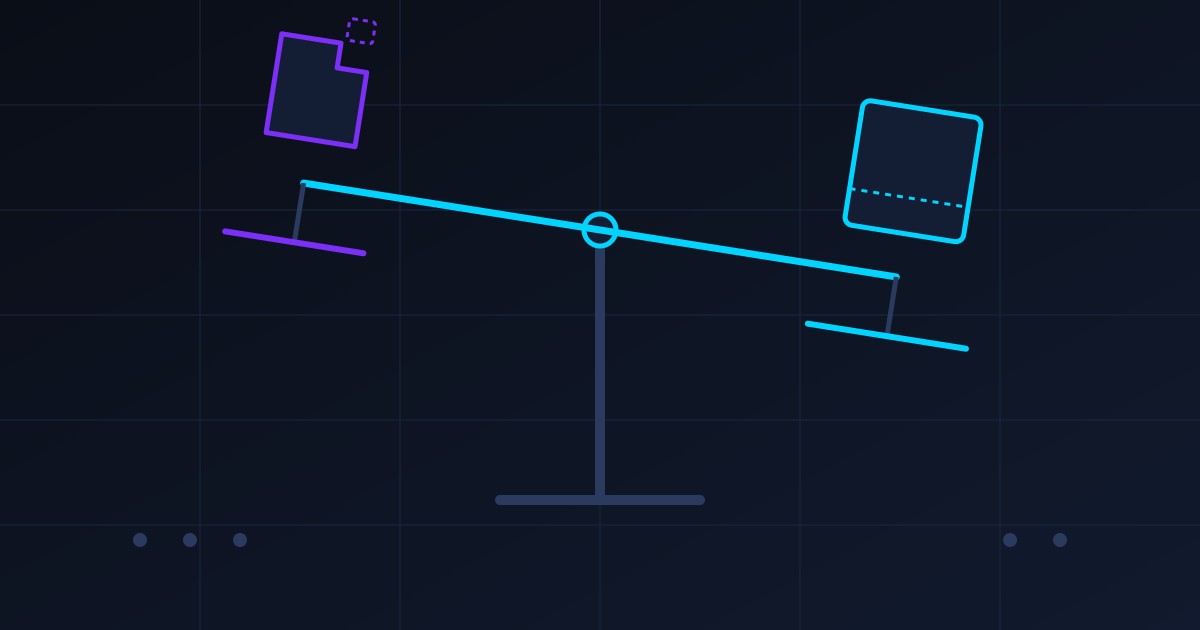
If you lose 20% of your starting amount, you need a gain of 25% to get back to where you were. The share you lose and the share you need to recover are not the same.
This article is for people who keep money in something whose price moves and want to sort out how to count the size of a loss.
By the end you will know three things:
- the gain needed to recover from each share lost, and the formula behind it
- how many losses in a row it takes to reach 20%
- how our funding plan table is built so that 5 losses come to exactly 20%
Every figure here is calculated from a formula. We checked what the funding plan table does by reading its screen and its calculation at 01:57 on 4 October 2026 (Japan time).
Please read this first
This is an explanation of arithmetic, not investment advice. Money placed in anything whose price moves can lose its principal.
We do not recommend trading any particular currency or using any particular exchange.
“Down 20%, so up 20% gets it back” does not hold
When 100 dollars falls by 20%, it becomes 80 dollars. A gain of 20% from there gives 96 dollars, not 100 dollars.
What is needed to get back is 20 dollars. Seen from 80 dollars, 20 dollars is 25%.
The order does not matter. If 100 dollars rises by 20% to 120 dollars and then falls by 20%, it is 96 dollars.
The difficulty is that this gap opens quickly as the share lost grows.
The amount is smaller after the loss, so the share needed is larger
There is one reason. A percentage applies to the amount at that moment. After a loss the amount is smaller, so recovering the same sum takes a larger percentage.
gain needed (%) = share lost ÷ (100 − share lost) × 100
For 20%, that is 20 ÷ 80 × 100 = 25%. The main cases are listed below.
- lose 10% → a gain of about 11.1% is needed
- lose 20% → a gain of 25% is needed
- lose 30% → a gain of about 42.9% is needed
- lose 50% → a gain of 100% is needed
- lose 80% → a gain of 400% is needed
- lose 90% → a gain of 900% is needed
Up to 10% the gap is small; at 20% it is 5 points. After losing 50%, what remains has to double to get back.
How many losses in a row reach 20%
If each loss is a fixed share of the amount at that moment, the amount shrinks by compounding. The share lost after n losses in a row is given by this formula.
share lost = 1 − (1 − share lost each time) to the power n
With this formula we count the losses in a row before the share lost reaches 20%.
- 1% lost each time → 23 losses (about 20.6% at loss number 23)
- 2% lost each time → 12 losses (about 21.5% at loss number 12)
- 5% lost each time → 5 losses (about 22.6% at loss number 5)
- 10% lost each time → 3 losses (about 27.1% at loss number 3)
With 5 losses of 5%, simple addition gives 25%, but compounding gives about 22.6%. Each loss leaves a smaller amount, so the sum lost each time also gets smaller.
The smaller each loss, the more losses in a row it takes to reach 20%. This is a matter of arithmetic and says nothing about how likely a win or a loss is.
The formula does not include fees. It also does not include the case where the price jumps and more is lost than the loss you had set.
The funding plan table is built so that 5 losses come to exactly 20%
The funding plan table in our Hype Trade puts this arithmetic into a table. Enter an amount and it lists the amounts after 5 wins and after 5 losses.
The size of one step is worked backwards so that step 5 is exactly +20% and −20%. One loss is about 4.36% and one win is about 3.71%.
Each losing row shows the number of wins in a row needed to get back. In an example with 1,000 dollars, 5 losses in a row leave 800 dollars, and getting back takes 7 wins in a row.
5 losses are not recovered by 5 wins. From 800 dollars, 5 wins give 960 dollars. 25% is needed, and 5 wins come to 20%.
The table does not include fees, slippage or funding rates. It is a guide for managing money and does not show future results.
What tends to work, and common pitfalls
✅ What tends to work
Read a loss as the gain needed to recover from it. A loss of 20% becomes a task of 25%, and a loss of 50% a task of 100%, which makes sizes easier to compare.
⚠️ Common pitfalls
Counting on getting back with a gain of the same percentage next time. The percentage applies to the smaller amount left after the loss, so the same percentage does not get you back.
Frequently asked questions
Q. Why 20%?
It does not mean that 20% is the right answer. In arithmetic, it is the point where 25% is needed to get back. Where to draw the line is for you to decide.
Q. If I cut my losses, will I avoid losing money?
No. Cutting a loss is an action that makes the loss final. If the price jumps, you can lose more than the line you had set.
Q. Does this formula apply to any asset?
It is a calculation of percentages, so it does not depend on the kind of asset. It does not include costs such as fees.
Summary
- lose 20% and 25% is needed to get back; the formula is share lost ÷ (100 − share lost) × 100
- lose 50% and 100% is needed; lose 90% and 900% is needed. The more is lost, the faster it grows
- at 1% lost each time it takes 23 losses in a row to reach 20%; at 5%, 5
- this is an explanation of arithmetic, not investment advice; the principal can be lost
To lay out the same calculation for your own amount
The funding plan table in Hype Trade takes an amount and lists what it becomes after 5 wins in a row and after 5 losses in a row, with the number of wins in a row needed to get back. It opens without logging in.
Fees and similar costs are not included. It is not a recommendation to buy or sell, and it does not show future results. Orders are not currently accepted through this service.
This article is an explanation of arithmetic, not investment advice. Money placed in anything whose price moves can lose its principal.
We do not recommend trading any particular currency or using any particular exchange.
Categories